
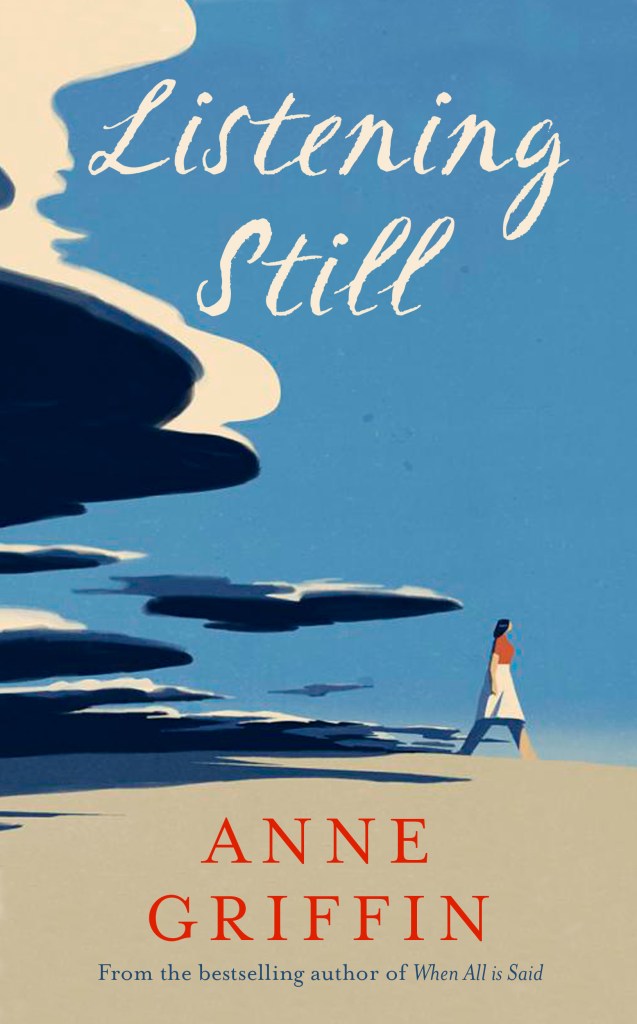
Blurb
Jeanie Masterson has a gift: she can hear the recently dead and give voice to their final wishes and revelations. Shared by her father, the gift has enabled the family undertakers to flourish in their small Irish town. Yet, Jeanie has always been uneasy about censoring what she hears to protect the feelings of the living. Unsure too about the choice she made seventeen years ago, giving up the chance of a new life in London with her first love, Fionn, to work with her father and aunt-or the wisdom of marrying her faithful childhood friend Niall when she has never been quite able to forget Fionn. Until now, Jeanie has stifled her doubt, but when her parents unexpectedly announce their plan to retire and leave the business to her and Niall, she is jolted out of limbo.
Review
Anne Griffin’s welcomed successor to her debut novel, When All is Said, was widely anticipated, due in no small part to the gentle lull of her writing and the lucidity of her insights into people. From the first page, an intimacy is forged between the reader and Jeanie Masterson, who is defined by one word: Obligation. Throughout the span of the novel, we see Jeanie compartmentalising her own life in order to listen to the precious final words of the dead. In allowing them to speak, she is offering a balm of freedom, forgiveness and permission to leave- yet while imparting those final words to the living, she is painfully aware of the hurt such confessions can bring. The weight and suffocation of that dual obligation is constricting and Jeanie is floundering under the weight of such responsibility. She is not just a medium of transference or a messenger, she is required to use appropriate tact, withhold confessions when required, or sometimes, sometimes, reshape the entire message, to avoid any further pain for the living.
That obligation continues at home where Jeanie is suddenly expected to take over the family business with her husband. It continues when spending time with her brother Mikey, who relies on order and predictability, and so Jeanie enters his world under his terms in order to strengthen his confidence in the world. She is drowning under a sea of duty, altruism and an identity that is increasingly bound to those attributes.
Then there is her husband Niall- reliable, wonderful Niall who has loved Jeanie since school. This was a painful relationship to observe because the relatable elements of their history will ring true for many. Simply put, before Jeanie married Niall, Jeanie loved Fionn-in the fullest, most all-consuming way one can love another. The road of life has many forks, and this was the defining one for Jeanie. To have stayed in London with Fionn would have offered a different future, one of her own making. However, predictably, it was duty that called her home to Ireland and she married Niall and immersed herself in the family business.
Anne Griffin’s strengths lie in her knowledge of people. She knows their intricacies, their weaknesses and their desires. She knows the pull of desire and the attraction of familiarity, and in an Irish family, she knows the weight of tradition. In questioning the idea of destiny, she analyses how we oftentimes forge our own paths, how othertimes we walk the paths carved out for us by others, and how both of those options require tremendous bravery and sacrifice. Her characters were superbly crafted, each memorable in their own right. For me, Mikey was the one to watch throughout. His purity and the wholeness of his love will stay with me for some time, as will this novel as a whole.
What I enjoyed most about this novel was the experience of processing it, because in doing so, in allowing myself that time, I realised that Niall was duty-bound by his love for Jeanie. He was anchored into a place where happiness was second to the promises made to others. Jeanie’s family, and the history behind the Masterson business, was a cautionary tale of the obligations and secrecy in a family business. And Jeanie…Jeanie listens to so many others, she devotes her life to it and yet she fails to listen to herself, the most important person in her own story. The nod towards a culture which serves others was a strong foundation for a novel where tradition and respect for familial traditions is laced through generations of families. Rather than allowing Listening Still to be a lesson hard-won, Anne Griffin introduces a gentle optimism, the reality that often, it takes phenomenal courage to break from tradition and to prioritise yourself and your story. In doing so, we can find a way to blend tradition and self development. A captivating and thoroughly enjoyable novel about the importance of listening to yourself, written under the insightful, watchful eye of Anne Griffin whose artistry narrows borders and timelines in order to allow us to face our own history.
 The Book Nook